Paper, Clay, Metal
Old Knowledge, New Uses
There is something interesting about working
with materials that have been used for hundreds,
sometimes thousands, of years.
Their properties are well understood,
yet there always seems to be something new to discover.
Paper, clay, and metal have accompanied everyday life for centuries.
They have been made into objects for writing,
storing, eating, worshipping, and countless other purposes.
Their forms have changed with the needs and habits of each generation,
but much of the knowledge behind their making remains remarkably relevant.
At SSLK, we are interested in this continuity.
Not necessarily in recreating objects from the past,
but in understanding how traditional materials
and techniques might find new purposes in contemporary life.
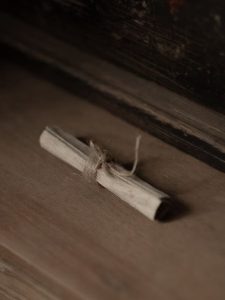
Paper
Paper is perhaps the most familiar of the three, and one of the easiest to overlook.
Traditional Chinese papermaking begins with plant fibres.
Bark, bamboo, hemp, and other materials are processed, softened,
and beaten into pulp before being suspended in water and formed into sheets.
The choice of fibre, the way it is prepared,
and the drying process all affect the finished paper.
Some sheets are remarkably thin yet strong.
Others are coarse, soft, translucent, or marked by visible fibres.
Even papers of similar colour can feel entirely different in the hand.
We have explored various handmade papers for SSLK,
particularly for wrapping incense and producing printed materials.
A beautiful sheet, however, is not always a practical one.
Some fibres loosen along a fold; certain surfaces are difficult to print on;
other papers are simply too fragile for repeated handling.
Choosing paper therefore involves more than finding a texture we like.
It requires understanding what the material can do, and what we are asking it to do.
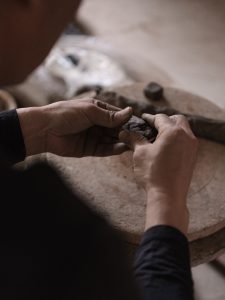
Clay
Clay is less predictable.
It begins as earth and water, soft enough to be shaped by hand.
As it dries, it shrinks. In the kiln,
heat brings further changes to its structure, dimensions, and surface.
The process leaves room for variation.
A slight irregularity in the edge, a subtle difference in texture,
or the way a glaze settles can distinguish one piece from another.
These are qualities we appreciate, but they are not reasons to overlook function.
An incense holder must remain stable.
Its proportions need to accommodate the incense,
and its shape must account for the ash that falls during burning.
The challenge is not simply to create an attractive ceramic object,
but to find a form in which the nature of the material
and the requirements of everyday use can coexist.
Metal
Metal offers an entirely different set of possibilities.
Iron, silver, brass, and other metals each have their own physical qualities.
Some are valued for their strength, others for their malleability,
weight, or the particular way their surfaces respond to light and time.
Iron has a certain directness to it.
It is strong, relatively inexpensive,
and has long been used to make both practical tools and everyday objects.
Silver is softer and more workable, allowing for delicate forms and fine details.
Brass, an alloy of copper and zinc,
has a warmer colour and a surface
that gradually changes through use and exposure to the air.
None of these materials is inherently
more suitable simply because it is more precious.
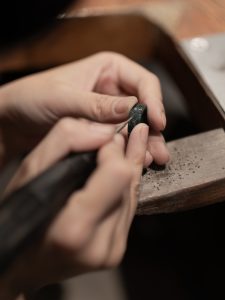
At SSLK, we have experimented with iron and worked
with a designer to develop an incense holder in sterling silver.
We are also interested in exploring brass and
other metals as our collection of objects continues to develop.
The choice of material often begins with simple questions.
How should an object feel in the hand?
How much weight does it need?
What happens to its surface after years of use?
And which manufacturing techniques would best suit its form?
Metalworking has a long history in China,
from bronze casting and iron forging to the more delicate techniques
of working with precious metals. Many of these methods continue to be practised today,
often alongside contemporary tools and technologies.
We find this particularly interesting.
The same knowledge that once served the making of agricultural tools,
household utensils, and ceremonial objects can still inform
the design of something as small as an incense holder.
There is no need for a contemporary object to imitate an ancient one. Sometimes,
the most meaningful continuation of a craft is simply to give it another purpose.
Making Use of What Came Before
In Chinese, there is an expression,
古为今用 — drawing upon the knowledge of the past to serve the needs of the present.
We find this a useful way to think about craftsmanship.
Traditional techniques do not have to remain attached to traditional forms.
A material once used for a particular purpose may be adapted to another.
An established method can be studied, adjusted,
and applied to objects that belong unmistakably to our own time.
This is not always a straightforward process.
Old methods have their limitations, just as contemporary designs
have their practical demands.
Much of the work lies in understanding where the two can meet.
At SSLK, incense is often the starting point,
but our interest extends to the objects that accompany it —
the paper that is unfolded, the vessel that collects the ash,
and the small metal piece that is handled each day.
We want these things to be used, rather than merely admired.
Paper will be unfolded and creased.
Clay may acquire traces of use.
Metal, depending on its composition and finish,
may change in colour or develop a patina over time.
There is nothing particularly unfortunate about any of this.
After all, these materials have endured for so long not because
they were kept apart from everyday life,
but because people continued to find uses for them.
We hope to do the same, in our own small way.